
COMPARED TO WHAT | 4 Ideas for Healthy Comparisons
“Division is the most powerful arithmetic operation. It makes comparisons.” ~ Sanjoy Mahajan
We all make comparisons to other people. I wish I was as fast as X; at least I’m not as unlucky as Y; can you believe Z, I would never stand for that. Sometimes these comparisons are helpful and healthy. They can serve as a perfect starting point for improvement. For example, I love content. I study the art of consuming and creating content. Generally, I think I’m pretty good at it, but when I compare myself to the following individuals, I see opportunities for growth:
- Michael Schechter - how could I begin to start producing more content consistently?
- Christopher S. Penn - how could I increase the amount of high-quality content I consume daily?
- Yuvi Zalkow - how can I make content that is more creative and contains relevant humor?
Comparisons to others performing at a higher level takes a certain confidence. For the comparison to be helpful, you have to believe you can make progress on becoming better.
On the other hand, if you are comparing yourself to an unrealistic ideal or the other extreme by viewing yourself as superior to others, comparisons can be frustrating and unhealthy. I’m not an Olympic swimmer. There are good reasons why I’m not, I don’t aspire to be one, and comparing myself to that group of elites would not only be silly, but would lead to eventual frustration and disappointment.
So how do you use comparisons for good instead of for evil? Here’s four ideas:
- Find pacesetters to chase - determine areas in which you want to excel. Seek out people who are doing those skills exceptionally well and study them, learn from them, emulate them.
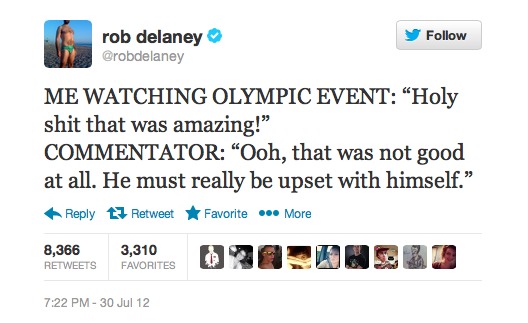
- Make meaningful distinctions - why is this person so good? What specifically makes their performance better? The tweet below from Rob Delaney sums up how the critical eye of the sports commentator sees more distinctions than the average viewer.
- Set realistic expectations for improvement - don’t expect to go from zero to 60 in 3.5 seconds. Improvement takes time and consistent effort. It’s more helpful to set “completion” goals rather than “be number one” goals.
- Evaluate your performance on a wider scale - in 2008, I ran in the Potomac River Run Marathon and finished 72. Which sounds fairly good, until you hear there were only 74 finishers. When I evaluate my performance on a narrow scale against the 74, it’s easy to feel discouraged about that result. I finished third from last. But when I expand that scale and compare myself beyond those 74 runners, then I was one of only 74 people who actually finished the marathon.
Use comparisons to improve, but be smart about your reference group. And as Marcel the Shell with shoes On says when people tell him his head is too big for his body, “And then I say, ‘Compared to what?’”
LISTEN TO THIS | The Genghis Khan of Ants
I’m a podcast junkie, and LISTEN TO THIS is a recap of my favorite tidbits, soundbites and short bursts of brilliance from this week. After digesting hours and hours of podcasts, here’s the top 3 must-listen-to moments.
THE GENGHIS KHAN OF ANTS
I’m a avid student of variation, I believe many things can be better understood with bell curves and two-by-two grids, and I spend most of my day job working to reduce variation and figure out how to ensure we deliver a consistent experience across multiple retail locations. Given that bias, I was riveted listening to this fascinating story of how Argentine ants have spread across the planet and managed to maintain genetic purity and consistency. You’ll miss some of the perspective of the complete story, but for a quick recap and the discussion of possible analogies to humans behavior, start at 14:10. If you get engrossed in the full history like I did, check out this stylish graphic detailing the ants path to global domination.
FINGERS ON KEYS
SIX PIXELS OF SEPARATION | #317 - Get Writing With Jeff Goins
Mitch Joel reads a lot and writes a lot. I want to read more and write more, so I sometimes I ask those who read a lot and write a lot how they do it. When I asked Joel, it let to this somewhat awkward exchange, but this episode helped me better understand why that Q&A played out like it did. Quit worrying about how to do something, and just start doing it. The entire episode is motivating, but for those short on time advance to 8:04 to hear the “Shut up and write” message. And for a little bonus, skip to 24:50 and hear how Mother Theresa answered, “How do you pray?”
THAT WORD REAL
FREAKONOMICS RADIO | Freakonomics Goes to College, Part 1
The first half of this episode is an interview with retired FBI agent Allen Ezell who created and oversaw operation DipScam (Diploma Scam) for 12 years. Ezell believes that 1% of all college credentials are fake including all kinds of medical degrees. It was fascinating to hear how he investigated diploma mills and various forms of forgery. But the memorable soundbite comes later in the show when host Stephen Dubner interviews Karl Rove about not finishing college. At 19:35, Rove explains the best course he took in college - Shakespearian Literature.
“It made me aware of the power of language and how telling a story - a political campaign is about big issues, but you have to describe a narrative. You have to create a story line. You know, what is this all about.” ~ Karl Rove
Podcast Test Drives:
Grammar Girl - I have not been a fan of the Quick and Dirty Tips network. The podcasts tend to be filled with motherhood and apple pie style, superficial advice - floss once a day, always use sunscreen, seek to understand first. I felt that way about the first episode of Grammar Girl that I listened to, but the second one on a great grammar hoax hooked me. STATUS: keep listening a little longer.
Here’s what really impressed me. Mignon Fogarty is masterful at integrating sponsorships into the podcast. If you’re a podcaster looking to increase sponsorships, listen to the way she weaves in the message about Audible.com at 9:22 on the grammar hoax episode. Seamless.
Unsubscribing from:
NPR Columns: Sunday Puzzler - fun and fast, it’s just not getting played on regular basis and there are lots of NPR podcasts in my subscriptions.
OTHER PODCAST POSTS YOU MIGHT ENJOY:
What about you? What podcasts did you enjoy this week and what do you recommend? Leave your favorites in the comments below.
STRATEGY | Predator or Prey?
On a trip to the zoo last weekend, I read this sign on the Tiger Trail that pointed out the differences in eye positions between predators and prey.

Eyes on a predator face forward. This allows them to focus their vision on their prey. Because both eyes are pointed in the same direction, their vision is binocular which gives them great depth perception. Eyes on prey are located at the sides of the head giving them good side and rear vision. Their vision is monocular, and they can use their eyes separately seeing two different objects on opposite sides of their body at the same time.
I had never thought about how important such a relatively simple and somewhat obvious characteristic like the placement of the eyes could be. My first reaction was that makes so much sense. Predators need to see different things than prey and vice versa. Then my second reaction was what a powerful metaphor for business strategies. Do you have a predator strategy or a prey strategy?
PREDATOR STRATEGY
Are you focused on looking forward? How’s your depth perception? Do you know how far and fast you have to move to achieve your target? Zappos, Southwest, and Apple are all examples of companies that look forward. They don’t care what others are doing to the side or behind them. They focus on their target and move towards solving real needs for their customers. Predators take risks and go for Yahtzee.
PREY STRATEGY
Are you focused on to what’s beside and behind you? Are you constantly worried about your competitors and what they are doing? Home Depot and Lowe’s, McDonald’s and Burger King, and Marriott and Hilton all strike me as prey competitors keeping a constant eye on each other. One half develops an innovation, and their pair competitor imitates to follow. They are focused backwards and to their sides.
This distinction reminds me of the difference between Warren Buffett and Eddie Lampert. Buffett’s annual letters tend to be internally focused answering where are they headed. Lampert’s tend to focus more externally describing what’s happening in the market around them. Where would you rather invest your money? Predator or prey?