
Breaking the logjam
WHAT I LEARNED
I had a logjam. The logs had piled up one at a time at first, and then started accumulating faster as the jam grew.
The first few logs in my lack of action on building out the Runner’s Lean website were lack of confidence. I didn’t have any answers, and I was unqualified to provide solutions. I wanted to test out exercises first and see if they made a difference for me.
Then came the research logs. I was curious to learn about the biomechanics of muscle fatigue in the back, but good content was hard to find, and I got easily bored with the scientific stuff.
Soon the runner logs hit the pile. Unexpectedly, runners experiencing the lean found the website and started reaching out to me. I was feeling the pressure of guilt for not responding or having more resources.
As the dam grew, I became more and more overwhelmed and ignored the project.
I was able to finally dislodge a few key logs this week by clarifying my aspirations for the Runner’s Lean website, brainstorming behaviors, and matching the behaviors that are most effective and that I’m likely to do.
SHOWING MY WORK
This is part 2 in a series where I’m challenging myself to work through the exercises in BJ Fogg’s Tiny Habits. If you missed last week’s edition, you can catch up here.
I started by mind mapping behaviors that would lead to my aspiration.
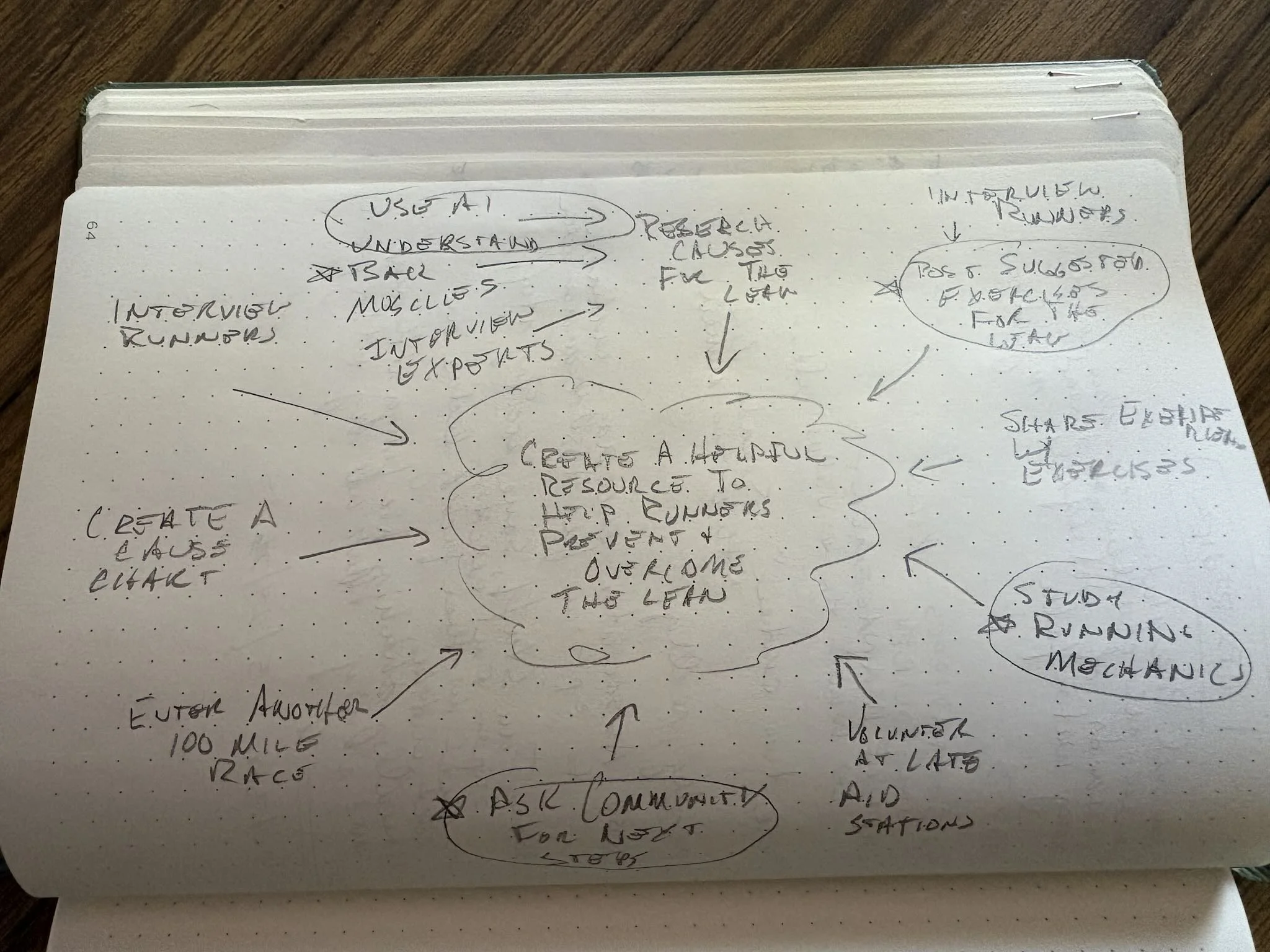
My pencil and paper mind map.
I starred the highly effective behaviors and circled those I could easily get myself to do. Behaviors that meet these two criteria are “Golden Behaviors.”
And here’s where the logs started shifting. I built a two-by-two grid, where the vertical axis is high impact to low impact, and the horizontal is can I get myself to do this no or yes? I then slid each behavior to the appropriate quadrant.
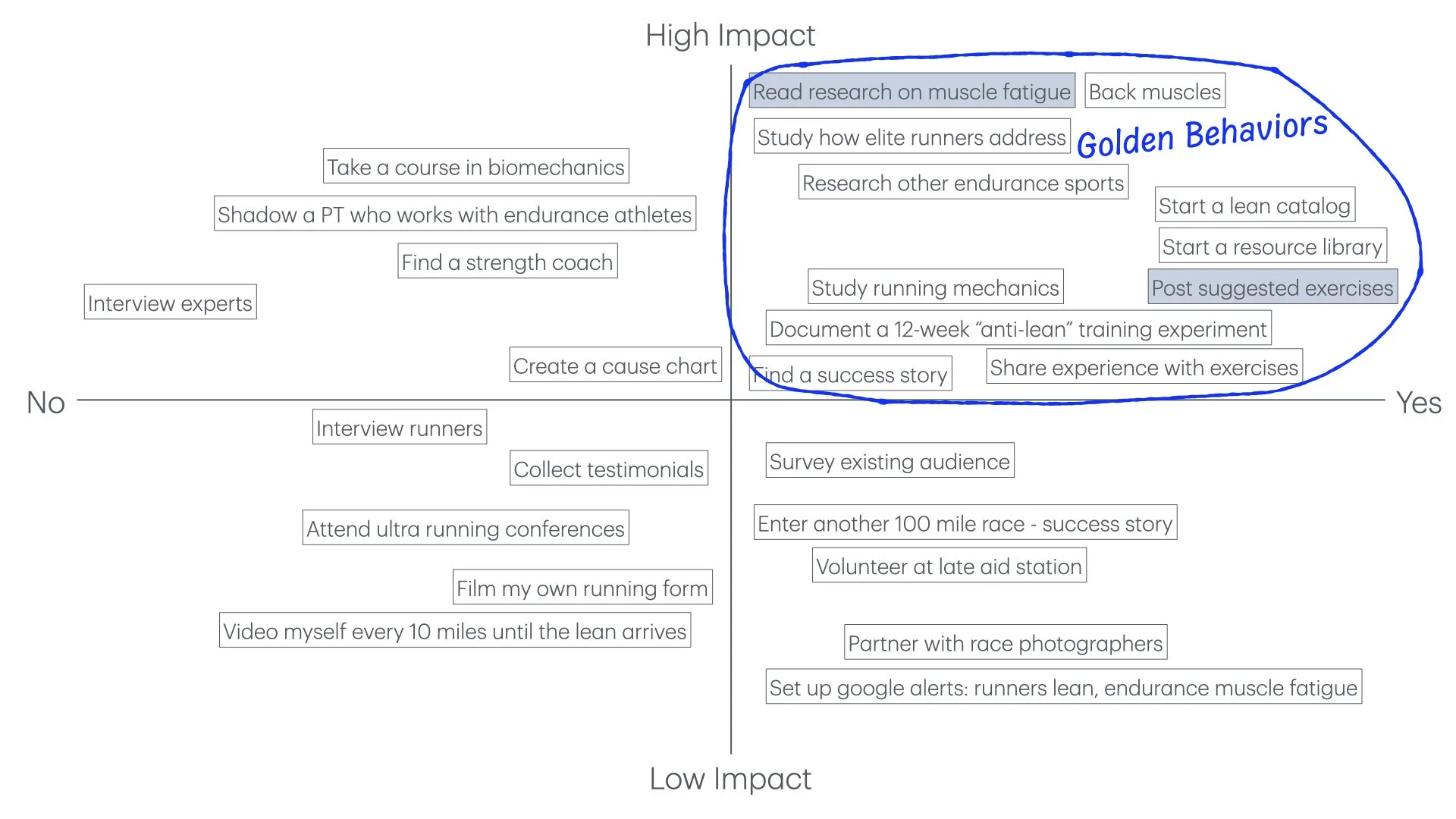
My golden behaviors grid.
Behaviors that have a high impact and I could get myself to do are considered the Golden Behaviors. These are the tools to dislodge the key logs. If I could loosen one or two of the blocking obstacles, then the motivation of that powerful river flowing underneath could take over and get things moving again.
NEXT STEPS
I’m at step 4 in Fogg’s Behavior Design Model, Start Tiny. The challenge this week is to start tiny on two Golden Behaviors.
Post suggested exercises: redesign the “Prevention Toolkit” page on the Runner’s Lean site. It’s currently in a blog format and will get long and difficult to use as I add more exercises. It would be more useful as a table with targeted muscles and links to videos on how to perform them. Once I have the format refined, I can look to add new exercises each week.
Read research on muscle fatigue: I want to learn more, but topic gets too scientific fast. Basic googling doesn’t produce much information, that’s why I originally launched the site. So the tiny behavior is to find one research paper I can actually read and understand.
Going through this exercise didn’t make the project any easier, but I stopped feeling overwhelmed and dreading taking action.