
Active Cognitive Resistance
THE RUB
From 1980 to 2014, obesity rates in America more than doubled, from 14% to 38%. In the same time frame, marathon finishes also dramatically increased rising from 87 per 100k to 225 per 100k. This chart shows the growth in both.
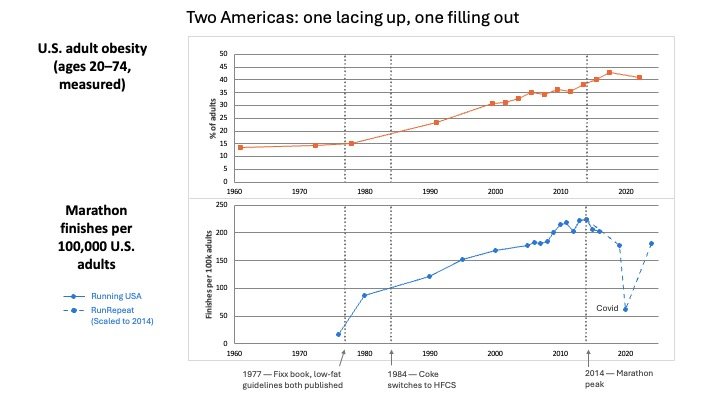
Obesity rates and marathon finishes since the 1970s.
Granted 38% of the population is much more than .2% of the population, but both trends increased over time at a similar rate.
Consider these contrasting milestone events in 1977. The McGovern Report published federal Dietary Goals and told Americans to cut fat. The food industry responded with a bounty of low-fat products. Since low-fat food tastes bad, they doctored those options with sugar and refined starch.
That same year, Jim Fixx published The Complete Book of Running. The running boom was well underway, but it took off in the late seventies. 1977 gave us the Jogbra and the first official running of the Western States 100.
I love this as a classic example of correlation does not equal causation. I love this even more as a tale of increasing resistance against easy and cheap. During this time calories became abundant, tasty, and mildly addictive. Yet a small group of resistors said, “I can expect more of my body.”
THE FRAMEWORK
Whether there’s a direct connection or not doesn’t matter to me. I find inspiration in the narrative that while much of the population was indulging from the trough of accessible, delicious processed food, a small group of healthy individuals pursued a different path and started running marathons. It’s not a clean story. The groups aren’t completely distinctive. Heck, I’ve been known to pack a baggie of Fritos in my running pack during long runs.
But I like the resistor mindset because it illustrates agency and grit.
Today, a new easy path that could have long-term effects is being paved — AI tools. If we start to outsource our critical thinking to AI, many fear we will become mentally lazy. Joanna Stern frames up the concern in I Am Not a Robot, “If AI becomes the thinking assistant students lean on too early and too often, we could end up with a generation that's always able to access AI for knowledge but has had far fewer chances to build judgment. They'll have the outputs, but not the instincts.”
I use AI every day. I use it for this newsletter to brainstorm, research, edit, and clearly for the images at the top of each edition. Over the last couple of years, I’ve also used it to do some thinking and writing for me. Some of it was slop, some of it was good.
Writing this weekly newsletter has helped me discover the value of writing first drafts from scratch. It’s been a journey to observe lessons in life, research what others think, and deliberately practice to improve.
Like the marathon runners in the decades of easy calories, it’s time to embrace a deliberate path of active cognitive resistance. What steps can I take today to ensure in 20 years I’m more mentally fit than I am today?
THE PRACTICE
Reading and writing are the push-ups and squats of cognitive strength training. I came to reading later in life. It's funny because it was the same with running for me. Through high school and college, I wasn't very athletic and not much of a reader. Once we had kids, I wanted to make sure I was role modeling reading to them. We subscribed to a couple of magazines, and I often was reading a book or two.
Over the last 10 years, I've let my reading habit diminish. I've fallen into the short-form trap, but starting at the beginning of this year, I worked to build back my long-form reading habit. I’ve been consistently making time for at least 20 minutes a day. From now till the end of the year, I'm going to challenge myself to see if I can commit to a full hour a day. Warren Buffett said, “Read 500 pages like this every day. That’s how knowledge works. It builds up, like compound interest.”
Writing comes easier for me. I keep a pen and paper journal with me most of the time, and I enjoy making observations. The level-up opportunity is can I expand my thinking to create more long-form resources and tools. In the foreword to The Daily Drucker, Jim Collins tells the story of asking Peter Drucker which of his twenty-six books he was most proud of. Drucker snapped, “The next one.”